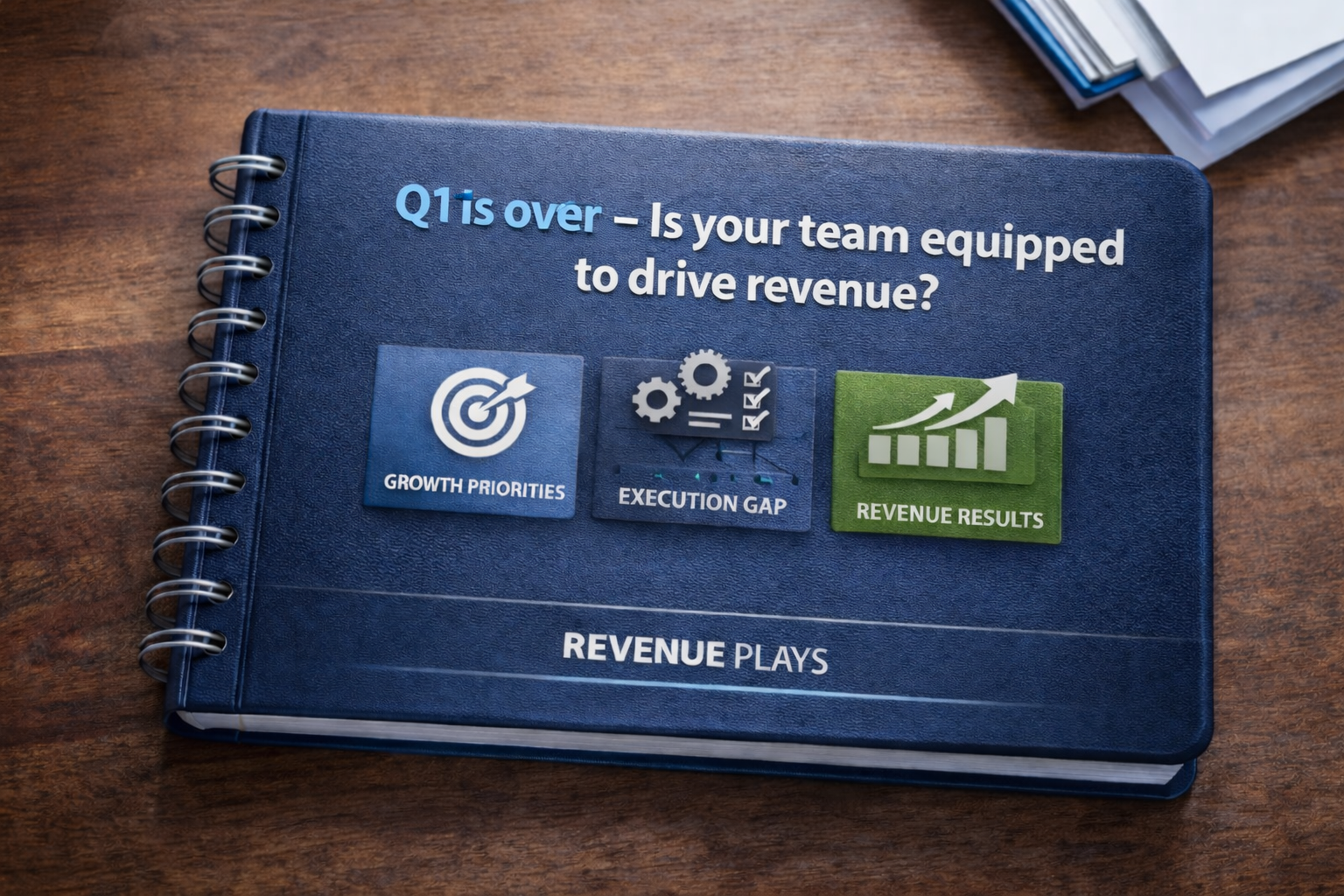
Q1 is over – Is your team equipped to drive revenue?
At the start of the year, every CRO defines clear growth priorities:
- Strategic accounts to win
- Products or solutions to push
- Markets to expand into
But now that Q1 is behind you, the real question is:
Is your team actually executing against those priorities – or just staying busy?
For many organizations, the answer is uncomfortable. Despite strong strategy, pipeline creation stalls, sales activity remains unfocused, and results lag expectations.
The Core Problem: Strategy Doesn’t Translate to Execution
Most sales organizations don’t fail because of poor strategy. They fail because execution never catches up.
According to the findings in this report:
- Sales teams often try to do too much at once, diluting impact
- Playbooks become “information graveyards” that sellers rarely use
- Training is treated as the solution, but behavior doesn’t change
Even well-known sales methodologies fall short because they:
- Aren’t tailored to specific growth priorities
- Lack clear guidance on what to say, show, and do
- Don’t align with real revenue outcomes
The Shift: From Sales Strategy to Revenue Plays
Leading commercial organizations are moving away from broad transformation programs. Instead, they’re adopting Revenue Plays – focused, execution-driven initiatives designed to move the needle quickly.
A revenue play is:
- Targeted → Focused on specific accounts, solutions, or opportunities
- Time-bound → Typically executed over 1-2 quarters
- Actionable → Clear guidance on what sellers should do, say, and prioritize
- Measurable → Tied directly to pipeline and revenue outcomes
Why Revenue Plays Work
Revenue plays succeed because they eliminate the gap between strategy and execution. They align three critical components:
1. Clear Priorities
Not everything is important.
Top-performing teams distinguish between:
- Core priorities (e.g., land, expand, retain)
- Opportunistic priorities (e.g., specific products, segments, competitors)
2. Seller-Level Execution
Revenue plays give sellers clarity on:
- Where to focus (accounts, personas, opportunities)
- What to say (messaging and positioning)
- What to show (assets, insights, proof points)
- What to do next (actions that drive deals forward)
3. Ongoing Enablement (Not One-Time Training)
Successful execution requires:
- Continuous coaching
- Real-time performance tracking
- Iteration based on results
Not just a kickoff event.
Why Most Sales Initiatives Still Fail
Even with good intentions, many organizations fall into familiar traps:
- Launching new messaging without changing behavior
- Expecting sellers to “do everything to everyone”
- Over-relying on training as the solution
- Lacking leadership alignment and accountability
The result?
No sustained impact on revenue performance.
What Winning Organizations Do Differently
When revenue plays deliver results, a few patterns show up consistently:
- Strong executive sponsorship
- Cross-functional alignment (Sales, Marketing, Product)
- Clear success metrics and timelines
- Active sales management involvement
- Technology used to track adoption and performance
Most importantly:
They treat execution as a managed system, not a one-time initiative.
Where to Start
If your team isn’t where it should be after Q1, don’t launch another broad transformation.
Instead:
- Identify 1-2 high-impact growth priorities
- Build a focused revenue play around them
- Align messaging, process, and coaching
- Track execution weekly
Start small. Execute well. Scale what works.
Final Thought
Strategy doesn’t create revenue.
Execution does.
And the fastest way to improve execution is to focus your team on the plays that matter most.
Want the Full Framework?
This blog only scratches the surface. For a deeper breakdown of how to design and implement high-impact revenue plays, read the full report:
Revenue Plays Findings