What Is Sales Coaching for B2B Teams?
Sales coaching for B2B teams is a structured process for improving the skills, behaviors, and decision-making that influence sales performance. Unlike one-time sales training or routine pipeline reviews, effective B2B sales coaching uses real sales conversations, deal data, targeted feedback, practice, and follow-up to create measurable behavior change.
For B2B sales leaders, the challenge is creating a repeatable coaching process that managers can use consistently across reps and opportunities. A practical sales coaching framework gives teams a structured way to identify performance gaps, coach specific behaviors, reinforce improvement, and measure whether those changes are showing up in the field.
Most sales coaching initiatives lose momentum within 90 days.
Managers fall back into deal inspection. Pipeline reviews become status meetings. Rep behavior slowly returns to old habits.
That is the real challenge of building a coaching culture in B2B sales.
The problem is rarely the methodology. The problem is reinforcement.
This is the central challenge of building a B2B sales coaching culture. It is not about finding the right framework or tool. It is about changing how managers show up every week moving from coordinating activity to coaching execution.
Why Sales Coaching for B2B Teams Fails Before It Starts
Before building a coaching culture, it helps to understand why the previous one did not work.
- Coordination disguised as coaching. Managers check in on deals, ask for updates, and move on. No behavior is challenged. No skill is developed.
- Generic feedback that cannot be acted on. “Be more consultative.” “Push harder on the close.” These are observations, not coaching. They do not tell a rep what to do differently at a specific moment in a specific conversation.
- One-time events instead of ongoing reinforcement. A methodology workshop, a speaker, a training day. Impactful for a week. As we have written about in Sales Transformation: Why It Requires More Than Just You, standalone training events rarely deliver the lasting change organizations need.
Effective sales enablement bridges this gap. It gives reps the tools, situational frameworks, and content they need before the coaching conversation even begins.
The distinction matters: coaching develops how a rep performs in real selling situations, while training primarily builds knowledge and skills.
The B2B Sales Coaching Framework
A sales coaching framework is not a methodology or a training program. It is a system that makes coaching consistent, specific, and repeatable regardless of which manager is running the session.
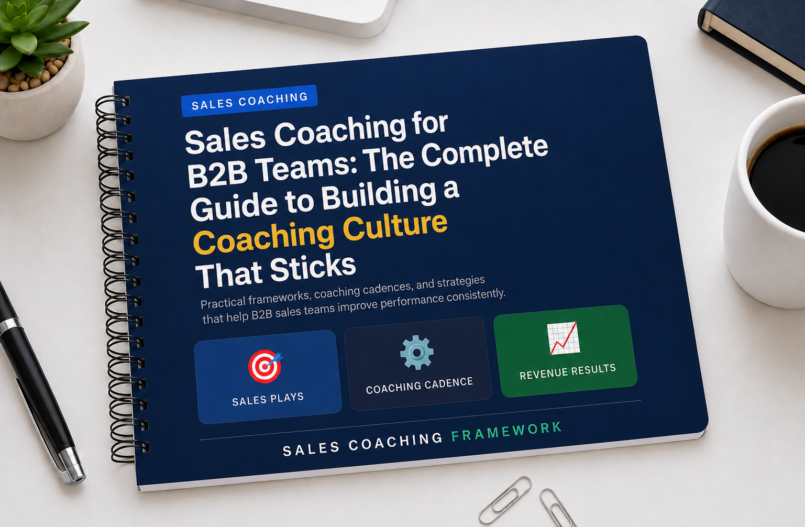
At Kodiak, we build this system around four components:
1. Defined Sales Plays by Situation
Coaching must reference something concrete. That something is a sales playbook a structured, situationally-specific guide for how a rep should approach each defined selling challenge. Most organizations train one generalized sales process. But reps struggle because different selling situations require different conversations, stakeholder strategies, and proof points.
A practical coaching process should move from observation to diagnosis, targeted practice, and verification. Managers need to see the behavior, identify the specific gap, coach the change, and then check whether the behavior improves in a subsequent interaction.
- New logo acquisition. How to open accounts, earn credibility, and create urgency with prospects who do not know you yet.
- Account expansion. How to move from one buyer and one category to multiple stakeholders and greater wallet share.
- Competitive displacement. How to dislodge an incumbent without leading with price.
- Stalled deal reactivation. How to re-open conversations that have gone cold.
2. A Sales Coaching Cadence That Sticks
Ad hoc coaching produces ad hoc results. A repeatable sales coaching cadence gives managers protected opportunities to review performance, develop specific skills, and reinforce behaviors over time.
The core cadence includes:
- Weekly 1:1 deal and opportunity reviews. Focused on stage, next steps, and where the rep needs support not deal storytelling.
- Bi-weekly team coaching calls. Where managers address patterns and introduce skill development tied to what is breaking down in the field.
- Monthly deal-level coaching. Deeper sessions on key opportunities qualification, stakeholder maps, advancement strategy.
- Quarterly calibration. Where leadership reviews coaching quality and whether the system is producing the outcomes it was designed to produce.
3. Coaching Guides and Qualification Tools
Coaching guides define what to inspect at each pipeline stage, what questions to ask, what behaviors to observe, and what good looks like versus what needs work.
Qualification frameworks, whether BANT, MEDDICC, or a custom model, give managers a shared language for evaluating deal health. When every manager applies the same criteria, the forecast stops being optimistic and starts being intelligent.
Our SalesOptyx platform packages these guides, playbooks, and qualification tools into an interactive environment reps and managers can access at the point of need.
4. How to Measure Sales Coaching Effectiveness
Most organizations measure lagging indicators: revenue, close rate, quota attainment.
A coaching culture requires leading indicators:
- Pipeline quantity. How many new deals were added since our last review? What activities are planned to increase pipeline?
- Stage conversion rates. Are deals advancing at the right velocity?
- Pipeline quality scores. How many opportunities meet the qualification standard at each stage?
- Coaching cadence adherence. Are managers actually running the sessions or letting them slip?
If managers are not running the cadence, nothing else produces data worth tracking. This is where sales strategy either gets reinforced or quietly dies in the weekly habits of the people responsible for executing it.
The Role of Sales Managers in B2B Sales Coaching
The single biggest leverage point in building a coaching culture is the front-line sales manager the person in direct, weekly contact with every rep. The front-line sales managers determine whether training survives or disappears.
As we explored in Equipping Your Team with Revenue Growth Plays, equipping managers is just as critical as equipping reps. Companies that invest in rep sales training while leaving managers to figure out reinforcement alone will see that training evaporate within a quarter.
Tools that make coaching concrete. Without a coaching guide, managers default to instinct. With one, they have three structured questions after every deal review:
- Which play did the rep run?
- Where did they deviate?
- What would have changed the outcome?
These questions turn every pipeline review into a development opportunity.
How to Make Sales Coaching Stick
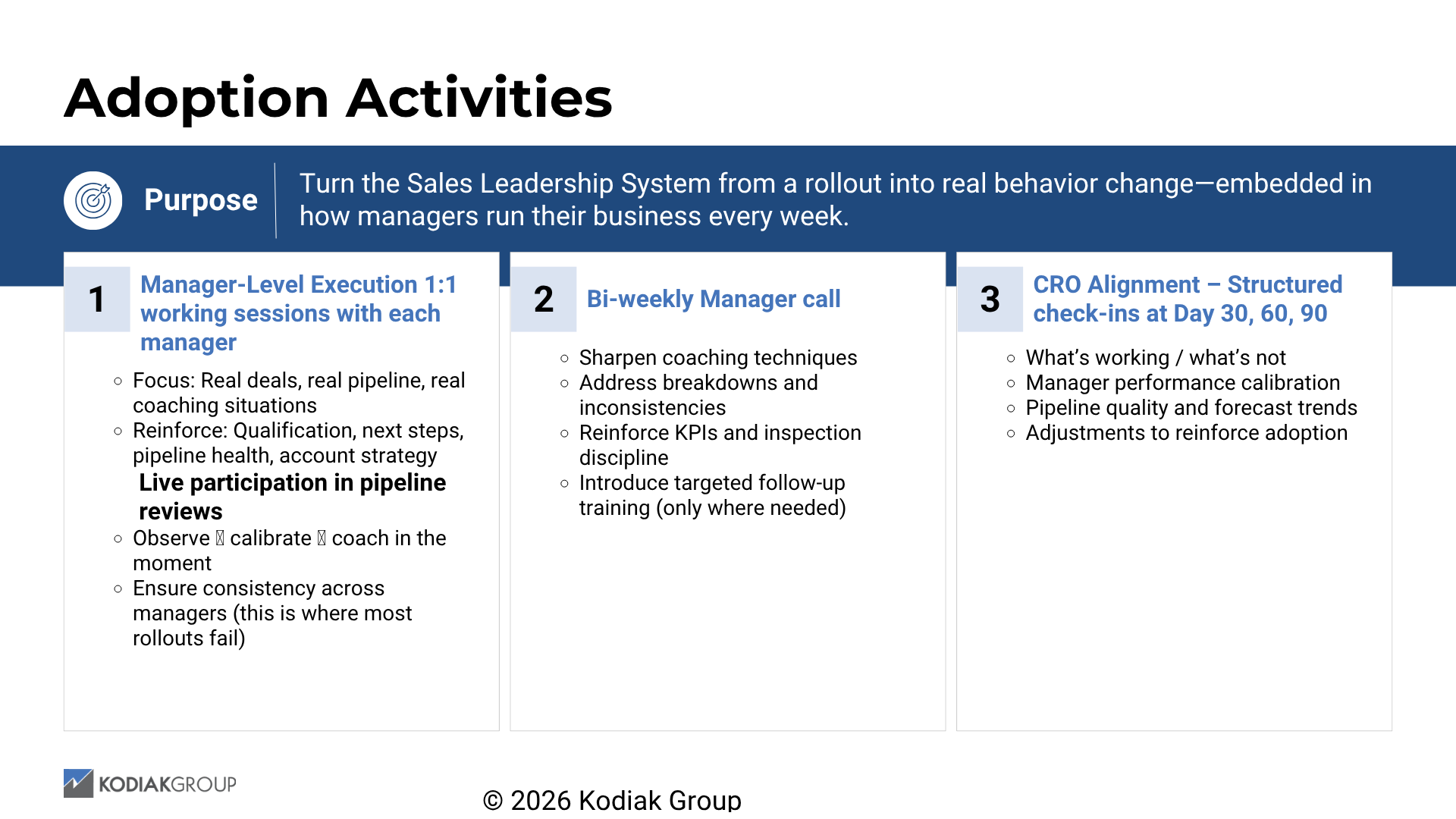
As Kodiak’s whitepaper 7 Keys to a Successful Sales Transformation outlines, transformation fails when only one person drives the change.
The elements that determine whether it sticks:
Executive sponsorship with real involvement. When the CRO participates in coaching sessions and holds managers accountable to the cadence, the message is clear.
Early wins celebrated loudly. The first time a rep uses the framework to advance a stalled deal, that story needs to be told to the entire sales team.
Honest 30/60/90-day inspection. Which managers are running the cadence? Where has rep behavior changed? Which plays are working and which need adjustment? Organizations that treat the first 90 days as calibration, not completion, are the ones that build cultures that last.
What Changes When Coaching Culture Takes Hold
- Middle-tier performance rises
- Pipeline accuracy improves
- New rep ramp time decreases
- Forecast reliability improves
The Bottom Line
The companies that get B2B sales coaching right stop treating coaching as something that happens after strategy is set. They use it as the mechanism that turns sales strategy, methodology, and enablement into repeatable field behavior.
If your pipeline reviews sound more like status meetings than coaching conversations, the issue is not your sales process.
It is your management system.
Coaching cultures are not built through motivational events or quarterly training sessions. They are built through consistent inspection, structured reinforcement, and managers who know how to develop behavior not just monitor activity.
That conversation is where it starts.
Kodiak Group builds sales coaching cultures for B2B organizations from coaching frameworks and pipeline inspection tools to manager development and 90-day adoption programs. If your sales coaching is not changing rep behavior, let’s talk.