A board-ready strategy isn’t the same as a field-ready sales organization.
We saw this recently with a B2B company whose board engaged a major strategy consulting firm. The work was serious. The market analysis was thorough. The go-to-market recommendations made sense on paper.
And then the deck was delivered.
The CRO was left staring at an entirely different problem:
- How do we actually implement this?
- How do we translate it to improve the way managers coach?
- How do we connect it to the CRM?
- How do we know whether the team is actually using it?
That’s where strategy efforts stall not because the strategy was wrong, but because no one built the operating infrastructure to make it real.
The Problem Is Not Always the Strategy
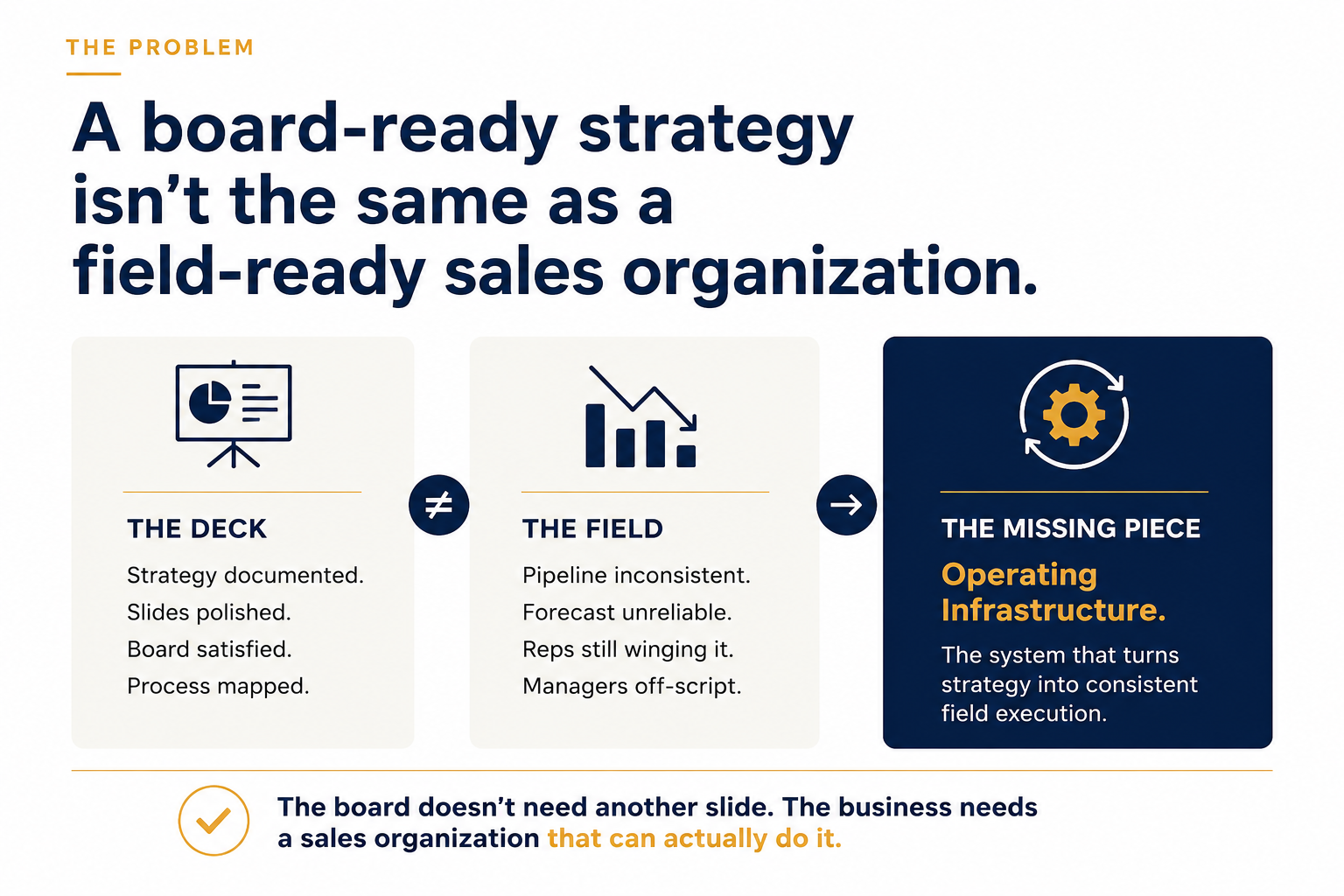
The gap isn’t the strategy. It’s everything that happens after the strategy.
In many cases, the strategy is right. The market analysis is solid. The recommended changes make sense. Companies that work with large strategy consulting firms often come away with the market sizing, the process maps, the recommended changes and still can’t move the number.
That’s the difference between a deck and execution.
Execution requires getting into the work alongside the team. Listening to actual customer conversations. Reviewing live opportunities. Pressure-testing the forecast. Building tools that managers will actually reach for every week not file away after the kickoff.
What Gets in the Way
The gap between strategy and execution isn’t a knowledge problem. Sales leaders usually understand what needs to change. They know where the team is falling short.
The gap is structural.
- There’s no coaching cadence connecting the new strategy to daily rep behavior.
- No inspection rhythm holding managers accountable for running the new plays.
- No standard for what a good pipeline review looks like so every manager conducts them differently.
According to Gartner’s research on front-line sales managers, managers have the single greatest impact on rep performance of anyone in the commercial organization. Yet in most transformations, manager enablement is an afterthought of a one-day session after all the important decisions have been made.
That’s why the strategy never becomes an operating system.
What It Actually Takes
At Kodiak, we build the operating infrastructure that turns sales strategy into behavior. Practical sales playbooks built around real selling situations. Account planning routines focused on the right customers. Pipeline inspection and forecasting discipline that reflects what buyers are actually doing.
And a leadership coaching system that makes all of it stick.
Most organizations don’t struggle because they lack ideas. They struggle because new processes never become part of the team’s daily workflow.
Reps attend training, managers receive new frameworks, and leadership aligns on a future-state vision. But without a consistent system of reinforcement, those changes gradually fade and teams return to old habits. Sustainable sales transformation requires more than introducing new plays. It requires embedding those plays into coaching conversations, forecast reviews, pipeline inspections, and account planning routines so execution improves week after week.
As HubSpot’s State of Sales research confirms, organizations with a structured coaching cadence consistently outperform those without one. The cadence isn’t overhead. It’s the mechanism that makes everything else work.
The Operating System, Not the Deck
Most sales enablement efforts produce content. A playbook PDF. A new CRM template. A set of updated slides.
That’s not a system.
A system is what happens when a rep knows exactly which play to run before a specific conversation. When a manager has a coaching guide that tells them what good looks like at each pipeline stage. When the CRO runs the same cadence with managers that managers run with reps. When Revenue Growth Plays aren’t sitting in a shared drive but showing up in actual conversations.
SalesOptyx was built for exactly this, delivering play-based content, coaching guides, and qualification tools at the point of need. Not during a quarterly training session. At the moment the rep actually needs it.
What This Looks Like in Practice
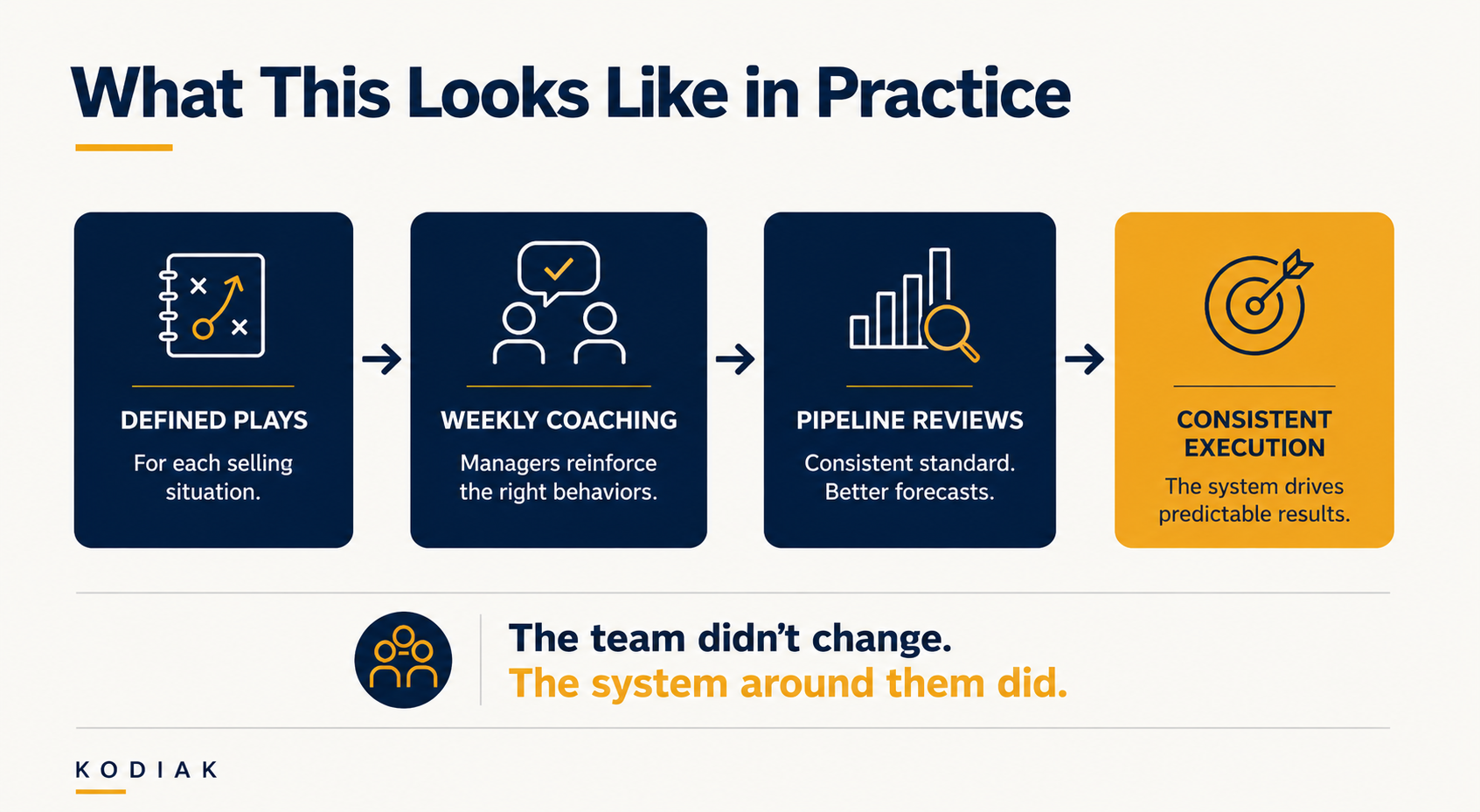
Managers inspect the same behaviors they expect from sellers. Forecast reviews follow a consistent standard. Coaching conversations reinforce the same plays across the team. Over time, execution becomes predictable because the system itself drives consistency.
Kodiak built the sales management infrastructure around the team. Defined plays for each selling situation. A weekly cadence managers could sustain. Coaching guides that told managers exactly what to inspect. A CRO alignment rhythm that cascaded the same discipline from the top down.
The result: improved win rates, faster rep ramp time, and a successful exit to a strategic buyer.
The team didn’t change. The system around them did.
What Winning Teams Do Differently
Sales transformation succeeds when strategy becomes behavior. That requires more than recommendations. It requires a system managers and sellers can execute every week. The board doesn’t need another slide showing what should happen. The business needs a sales organization that can actually do it.
That’s the work. And it’s where the Kodiak Group starts.
Kodiak Group builds the operating infrastructure that turns sales strategy into consistent field execution. If your sales organization is still running on the strategy deck instead of a real system, let’s talk.