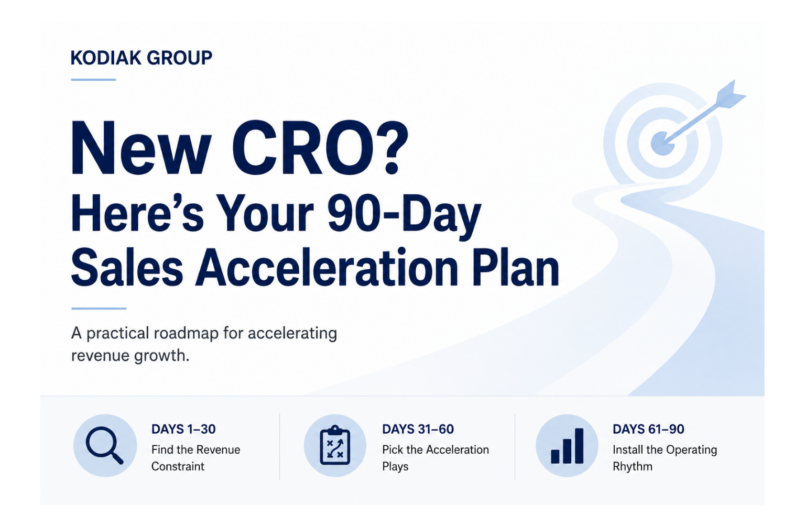
Most revenue leaders don’t fail because they lack talent. They fail because they move too fast.
Whether this is your first CRO role or you’ve led multiple revenue organizations through periods of growth, every new leadership transition presents an opportunity to learn.
At Kodiak, we’ve found that the most successful CROs balance learning with execution. Rather than rushing into change, they focus on understanding where revenue is constrained before deciding what to accelerate.
Here’s the framework we use to help CROs build momentum without creating unnecessary disruption during their first 90 days.
The Mistake New CROs Make In The First 90 Days
Many new CROs approach their first 90 days like a transformation project. Before they understand where revenue is constrained, they:
- Restructure teams
- Replace tools
- Introduce a new methodology
- Announce broad organizational changes
They declare a new direction before they understand what’s actually driving or dragging revenue.
Revenue acceleration rarely comes from adding more activity. It comes from identifying and removing the constraint that is limiting growth. You can’t find that constraint in week one. You have to earn the right to see it.
Most CROs aren’t hired because the company lacks ideas.
They are hired because growth has slowed, they need a new leadership voice, or they bring experience required for the next phase of growth.
The challenge isn’t finding another initiative.
It’s understanding why the current sales process isn’t producing the outcome the business needs.
The result is predictable: disruption without direction. Activity without momentum. And a team that’s left adjusting to change before understanding the reason behind it.
The best CROs don’t spend their first 90 days making dramatic changes. They spend their first 90 days building clarity about the team, the revenue operating system, the customer, and where revenue is actually breaking down. That’s what separates a sales acceleration plan from a transformation plan.
Then they move. With precision.
The 90-day Acceleration Framework
Phase 1: Learn | Find the Revenue Constraint (Day 1-30)
Before you change anything, you need to understand what’s driving performance today. Your job in the first 30 days is to listen, review, and diagnose before introducing major changes.
Start with CEO alignment
- What must be true 12 months from now for this to be a successful hire?
- What are your top concerns right now with the business? With the sales team?
- What has prevented revenue growth in the past?
- Where do you believe the biggest opportunity is right now?
- Who to meet in the first 30 days ?
CEO, CFO, and board | Understand Expectations and Constraints
- Marketing —> how is the pipeline generated and measured?
- Customer Success —> where are customers expanding or churning?
- Product — what are customers asking for that we can’t deliver?
- Top sales managers —> what does good look like on their team?
- Top performers —> why do they win? What do they see others missing?
- 5–8 current customers —> hear the truth firsthand
- 2–3 lost customers —> understand why deals didn’t close
Customer Questions That Matter Most
- Why did you buy from us?
- What nearly caused you to choose someone else?
- What do we do better than anyone else?
- Where do you wish we were stronger?
- Would you refer us? If so, to whom?
Revenue System Audit: What To Review
Every revenue problem leaves clues. Revenue constraints reveal themselves in the forecast, customer conversations, and the CRM.
Your job isn’t to gather more data – It’s to identify the pattern.
- Pipeline health and coverage by stage
- Win rates, loss rates, and reasons
- Average sales cycle length by segment
- Forecast accuracy and methodology
- Customer retention and expansion revenue
- Lead conversion rates by source
- CRM adoption and data quality
Warning Signs to Watch For
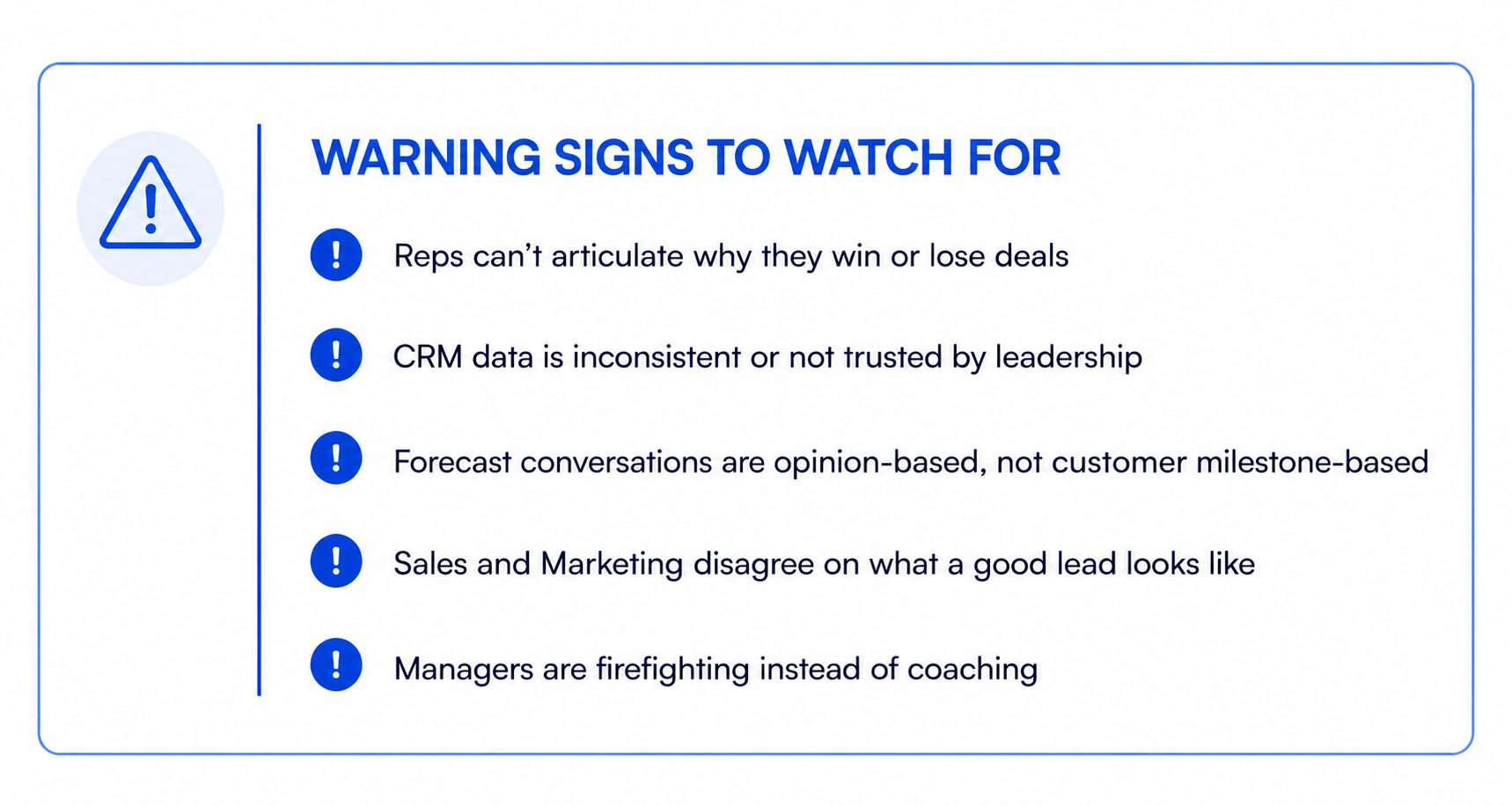
Set Goals Before You Leave Phase 1
Before moving to Days 31–60, document your initial findings and set 2–3 clear priorities that are aligned with the CEO, attainable within the quarter, and grounded in what you’ve learned, not what you assumed walking in.
Phase 2: Prioritize| Pick the Acceleration Plays ( Day 31-60)
Most organizations don’t have ten problems. They have one or two major constraints. Your job in Days 31–60 is to identify which constraint is costing the most revenue and select the 1–2 revenue growth plays most likely to move the number fastest.
The Kodiak Perspective On Prioritization
The fastest-growing revenue teams don’t launch five initiatives at once. They find the highest-leverage point in the system and focus there first. Spread attention across too many priorities and you move none of them meaningfully.
How to Identify Your Biggest Revenue Constraint
Most organizations don’t need more initiatives. They need more focus.
One constraint removed can create more impact than five new projects.
- Map the full funnel: lead → opportunity → close → retention → expansion
- Find where the largest drop-offs occur at each stage
- Quantify the revenue impact of each gap
- Identify the ONE constraint that, if removed, accelerates everything downstream
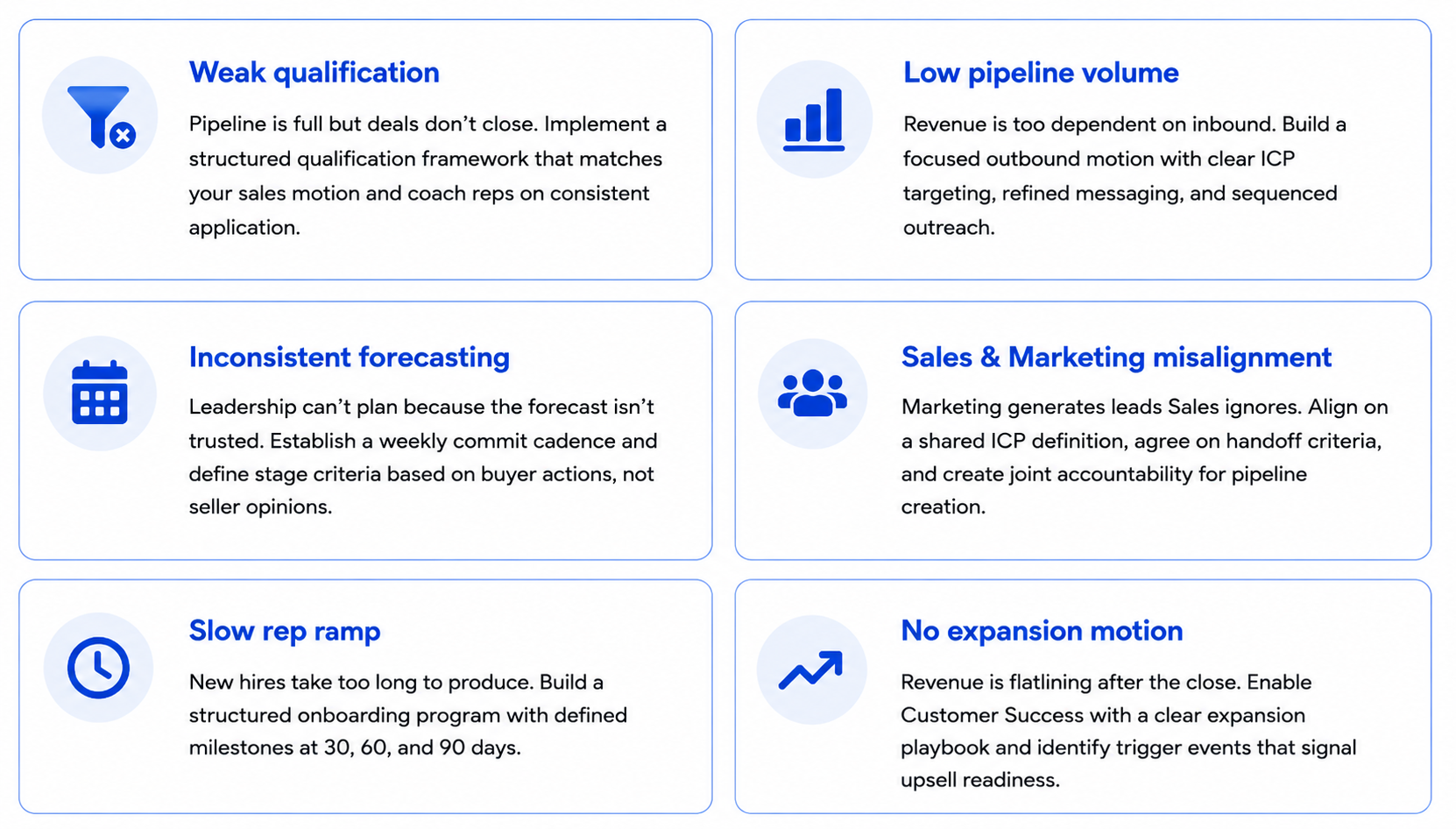
Common Constraints and the Plays That Address Them
If forecast accuracy is low because stage progression is inconsistent, standardize exit criteria before changing your forecasting process
The Difference Great Managers Make
Most CROs focus on sales reps.
The best CROs focus on managers.
Managers shape behavior, reinforce standards, and determine whether change actually sticks.
Sales managers are force multipliers. Strong managers build strong teams. By Day 60, you should have a clear picture of who is coaching effectively, who is managing by results alone, and where support or development may be needed.
According to Gartner’s research on sales management, front-line managers have the single greatest impact on rep performance of anyone in the revenue organization.
Phase 3: Install the Operating Rhythm ( Day 61-90)
By Day 60, you know the constraints. The diagnosis is complete.
You’ve identified the bottleneck.
You’ve chosen the plays.
Now comes the part most organizations struggle with:
Consistent execution.
Your job is to install the operating rhythm that keeps revenue moving and gives the organization visibility into what is working, what isn’t, and where to focus next.
The Revenue Operating Rhythm
- Weekly forecast reviews —> every manager presents commit, best case, and pipeline; hold each one accountable
- Bi-weekly pipeline inspections —> review deals by stage, rep, and segment; coach on next steps
- Weekly 1:1s with front-line managers —> focus on deal coaching and rep development, not status updates
- Monthly executive revenue scorecard —> forecast vs. actuals, key risks, pipeline health
- Quarterly business reviews — > step back, assess the full picture, adjust priorities
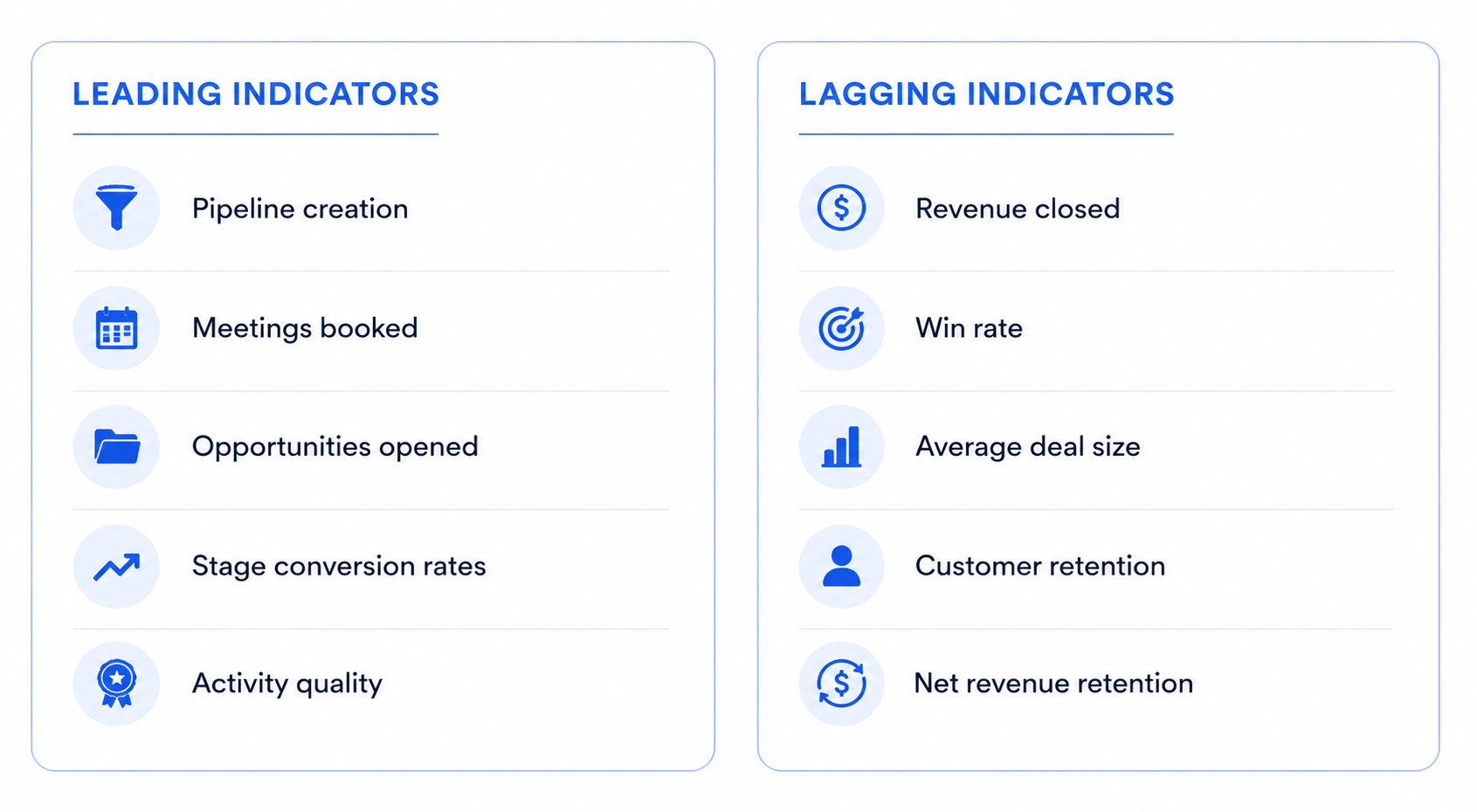
Build the Revenue Dashboard
What gets measured gets managed. But not all metrics are equally useful.
The goal isn’t to build a dashboard full of numbers.
The goal is to create visibility into the activities that drive growth. According to HubSpot’s State of Sales research, organizations with structured pipeline reviews see significantly higher forecast accuracy than those running ad hoc processes.
What’s Working vs. What’s Not
Every week, ask two questions: what is producing results, and what is not? The plays that aren’t moving the metric in 30 days either need to be adjusted or replaced. Don’t let momentum stall by protecting decisions made in week six.
Evaluate Talent and Team Readiness
Growth strategies don’t execute themselves.
People do.
Which is why talent clarity becomes increasingly important as the first 90 days come to a close.
By Day 90, you should know who can grow with the organization, who needs development, and where new talent is needed. Revenue growth accelerates when there is clarity about who can scale, who needs development, and where gaps exist.
Our SalesOptyx platform gives CROs and managers a structured way to assess rep readiness and reinforce coaching at the point of need.
The 90-day Roadmap Template
The best CROs don’t arrive with answers. They arrive with the right questions and the discipline to build a system that turns what they learn into predictable revenue growth.
Download the CRO 90-Day Sales Acceleration Roadmap (PDF)
Revenue Acceleration Starts with Clarity
The best CROs don’t spend their first 90 days making dramatic changes. They spend their first 90 days building clarity.
Clarity comes from understanding customers, aligning stakeholders, evaluating talent, and identifying the constraints that are limiting growth.
Sustainable revenue growth requires both leadership and discipline. It requires the ability to earn trust, create accountability, and align teams around a shared direction. It also requires systems, measurement, and consistent execution.
The most effective CROs do both. They build alignment first, then create the operating rhythm that turns revenue growth into a repeatable outcome. As we explored in Sales Transformation: Why It Requires More Than Just You, this kind of change only sticks when it is built on a coalition, not a single leader acting alone.
That combination leadership and execution is what separates a revenue leader from a revenue architect.
Kodiak Group helps newly appointed CROs and revenue leaders build the 90-day plan, the sales leadership system, and the operating rhythm that turns early diagnosis into sustainable revenue growth. If you are stepping into a new CRO role, let’s talk.