
We’ve never walked into a company that simply needed more sales training.
- The requests are always different.
- Revenue has stalled.
- Forecasts aren’t reliable.
- Managers aren’t coaching.
- The CRM is full of stale data nobody trusts.
- Leadership thinks they’re solving separate problems.
Most of the time, they’re solving the same one.
Every one of those symptoms traces back to a single root cause: different parts of the commercial organization are operating from different sales playbooks. Sales blames lead quality. Marketing blames sales for not following up. Ops blames the CRM. Nobody’s wrong; exactly they’re each looking at their own slice of a system that was never built to work as one.
Sales transformation is the process of aligning leadership, managers, sales processes, and systems around one consistent way of selling.
It’s not:
- Another training event
- Another tool implementation
- A rebranded compensation plan
Why Most Sales Transformations Fail
Sales transformation fails because organizations treat change as a one-time initiative instead of an ongoing operating discipline. They invest in training, CRM platforms, compensation redesigns, and restructuring, yet six months later, very little has changed in the field.
- A workshop happens
- Energy is high for a month
- High-performing reps gets pulled onto the next priority
- Organization quietly reverts to what it was doing before
The Common Mistakes Leaders Make
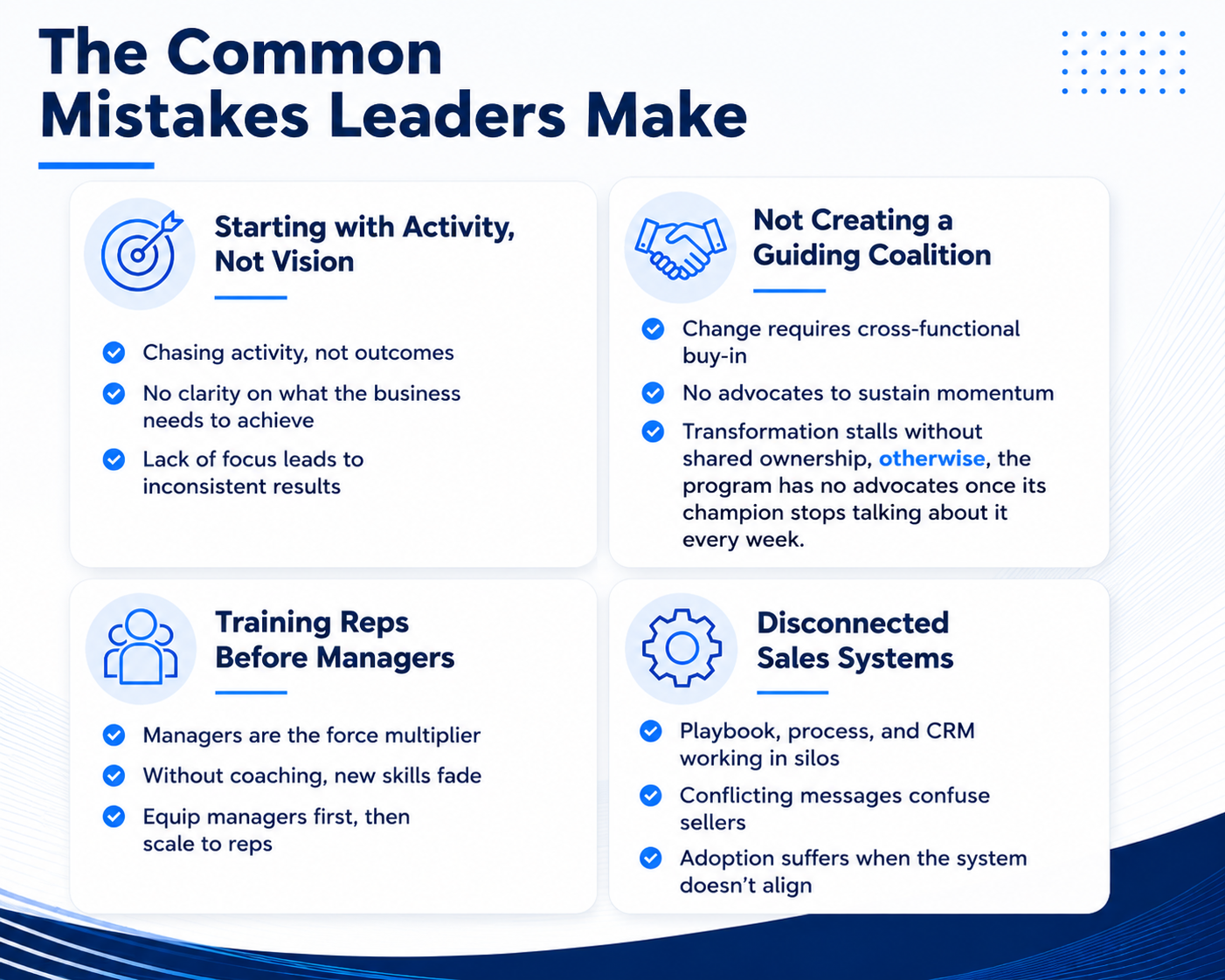
Many sales transformations fail for the same reasons: leaders jump into activity before defining the behaviors that drive results, treat change as a top-down initiative instead of building cross-functional support, train reps without equipping managers to coach consistently, and allow sales processes, playbooks, and CRM workflows to evolve separately instead of as one connected system. These gaps are exactly what our implementation framework is designed to solve.
The Framework We Use With Every Client
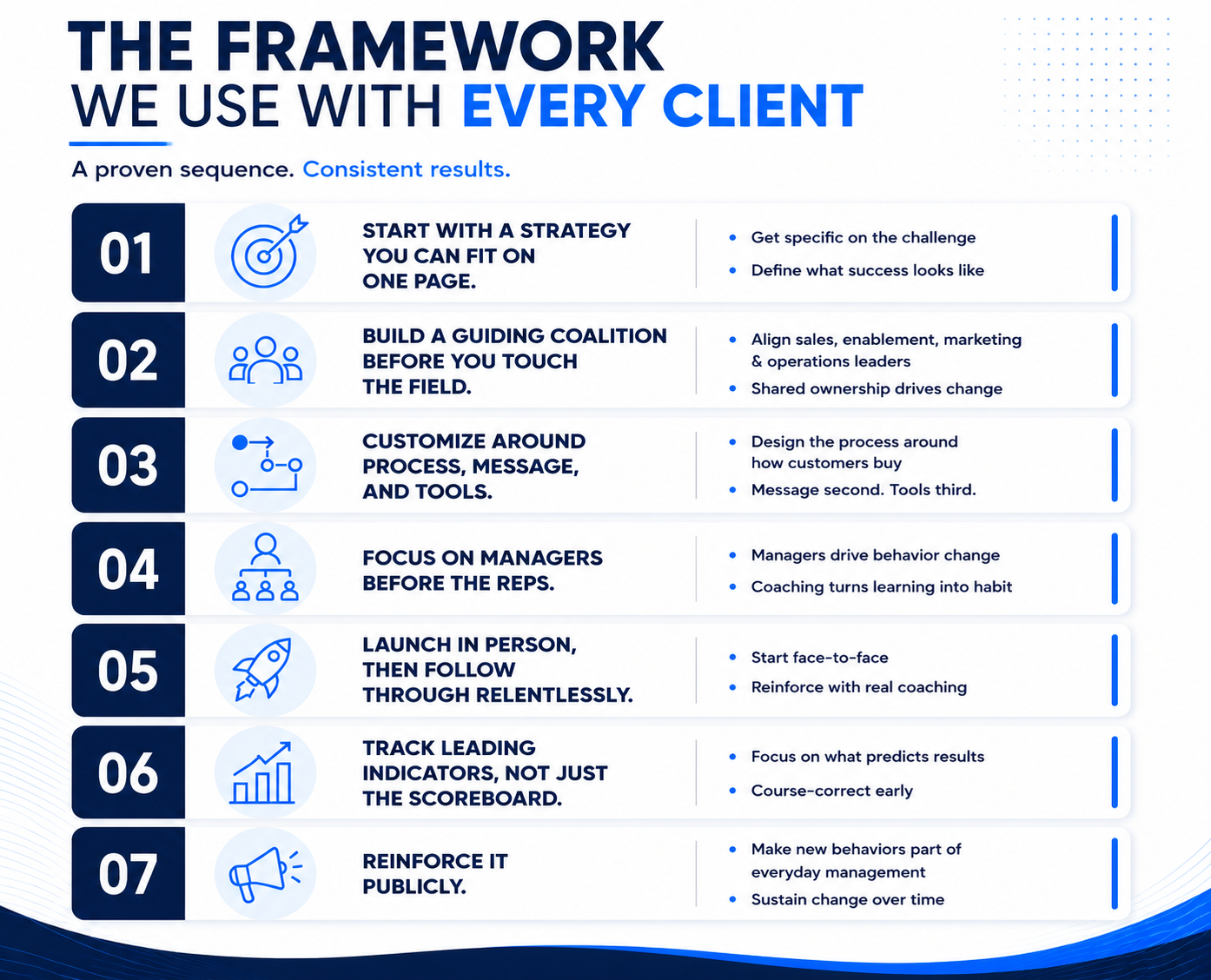
Over years of working with distributors, manufacturers, and industrial B2B organizations, we’ve found that successful transformations follow a surprisingly consistent pattern. Every company is different, but the sequence rarely changes.
1.Start with a strategy you could fit on one page. Before we touch a single seller, we get specific: what external challenge is the business trying to solve, and what success looks like in concrete terms. We push clients to distill this into something short enough to be shared and remembered.
2.Build a guiding coalition before you touch the field. Transformation isn’t something one executive announces. It’s something the organization collectively decides to reinforce. This is the step most programs skip, and where transformations quietly fail before they’ve started.
3.Customize the program around process, message, and tools in that order. We build the sales process around how customers actually buy, define a message every seller can repeat consistently, and only then select the tools. We’ve seen organizations spend months configuring CRM workflows before agreeing on how they actually want their teams to sell. That’s why adoption stalls. The system is asking reps to follow a process leadership never fully designed.
Focus on the managers before the reps.
One question we ask early in every engagement is simple: “Who owns behavior change after the training ends?”
If the answer isn’t the frontline manager, the transformation is already at risk. This is the foundation of ongoing sales coaching and sales management, a consistent cadence, not a one-time rollout.
4. Launch it in person, then follow through relentlessly. Knowledge fades fast without reinforcement. We launch face-to-face so managers and reps can practice together, then follow with real coaching that turns knowledge into skill and skill into habit.
5. Track leading indicators, not just the scoreboard. Revenue tells you what already happened. We track the leading indicators that predict revenue: pipeline velocity, meeting quality, and activity conversion.
6.. Reinforce it publicly. Organizations don’t sustain change because people remember training. They sustain change because new behaviors become part of everyday management.
What This Means for Leadership
The tools, the training, and the playbook are the easy parts. The hard part is leadership development: building leaders who hold the standard who hold the standard when the quarter gets hard. Transformation isn’t a project you launch. It’s a discipline you sustain, quarter after quarter, long after the initial energy wears off.
Managers play a critical role in making sales transformation stick. Companies with consistent coaching and impact measurement see 32% higher win rates and 28% higher quota attainment, according to Korn Ferry’s Sales Enablement Study. If frontline managers aren’t reinforcing new behaviors, the training is far less likely to stick.
Why Sustainable Change Takes More Than Training
It’s the slow work of getting every part of a commercial organization’s leadership, managers, process, and the field to operate from the same system, reinforced consistently enough that it becomes how the business simply works.
We’ve spent decades building that system with clients across software, healthcare, distribution, manufacturing, and other B2B industries. If your organization has all the individual pieces but they still aren’t operating as one system, that’s usually the real problem worth solving.
Sales transformation isn’t about launching another initiative. It’s about building a system your organization can execute every day. Kodiak Group helps B2B organizations create that system through sales strategy, manager development, coaching, and sustainable adoption. If you’re ready to transform the way your teams sell, let’s talk.

4 comments