
Private equity moves fast.
After a transaction closes, growth expectations rise quickly. New products need to get to market. Acquisitions need to be integrated. Sales teams need to move faster, speak more clearly, and execute with more consistency.
The default answer is usually a playbook or a training program.
That is not wrong. It is just incomplete.
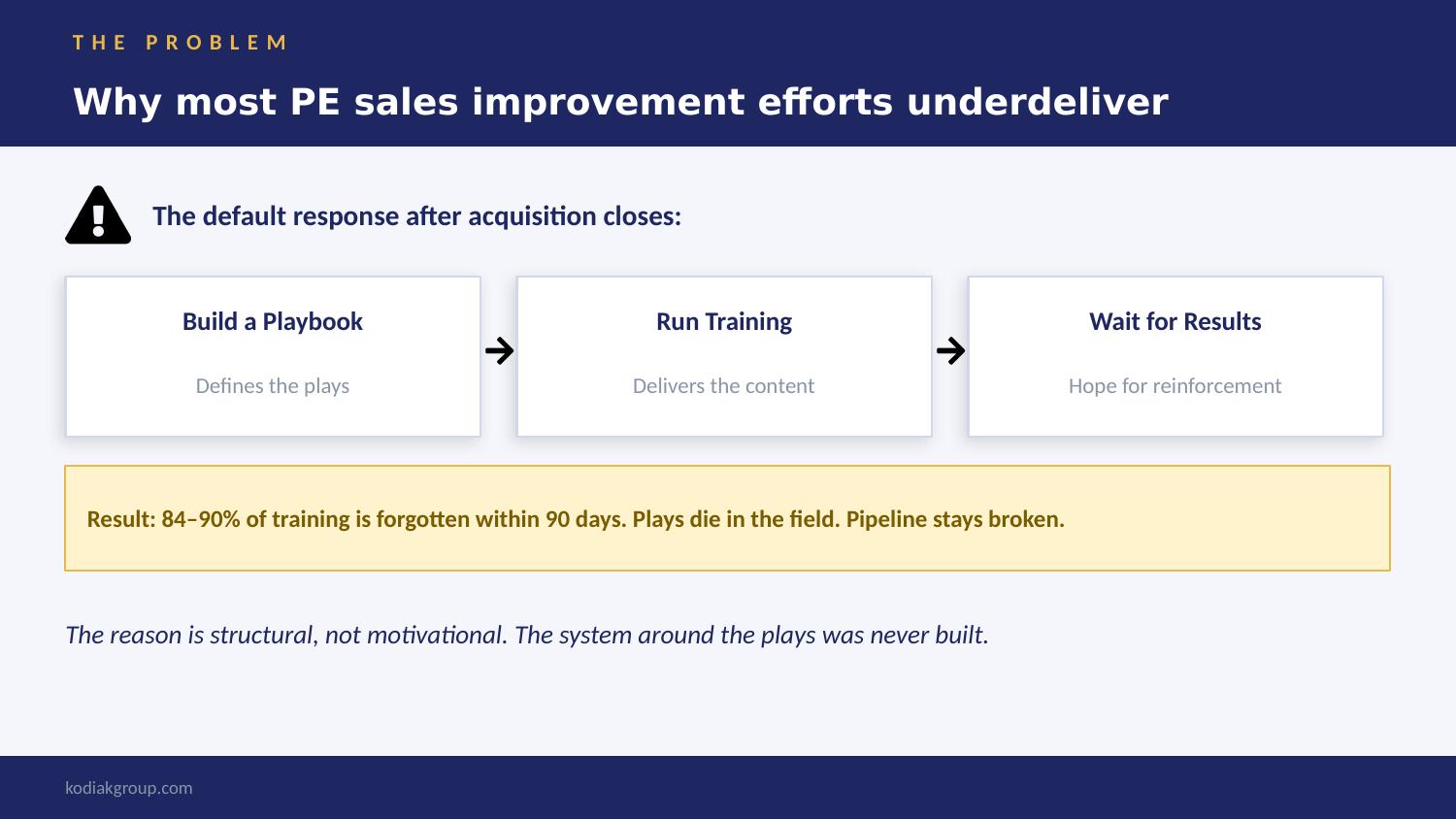
Playbooks matter. Sales training matters. But neither one improves sales performance on its own. The missing piece is almost always the same: manager coaching. Specifically, the absence of a system that equips managers to reinforce new behaviors after the training ends.
We saw this firsthand with a PE-backed manufacturer in the HVAC industry.
What a Real Sales Performance Problem Looks Like
The company had high growth expectations through new product launches, strategic expansion, and acquisitions. Their products were sold through internal sales teams, distributors, and independent sales agent groups. That meant the message had to land consistently across people who were not all managed the same way.
They did not just need a better sales document. They needed a way to translate growth strategy into daily sales behavior, a challenge that shows up in almost every sales transformation we work on, regardless of industry.
Kodiak helped build practical playbooks for new product launches, along with an account planning process focused on the right customers, opportunities, and channel conversations.
It was the coaching system built around it.
Because the question was never simply, “Did we create the playbook?”
The better question was, “Are managers using it to change how the team sells?”
Where Most Sales Transformations Stall
That is where most sales management efforts break down. A team builds a playbook. Leaders roll out training. Everyone agrees with the strategy. Then the business returns to old habits.
For a PE-backed company, that is costly. The growth plan cannot stay in a board deck. It has to show up in pipeline reviews, manager one-on-ones, and customer conversations.
That only happens when managers are equipped to coach the new way of working.
We see this repeatedly across sales transformations. Managers often have the biggest influence on rep performance, yet they are rarely given the same level of support and development.
The companies that improve sales performance do three things well:
- They define the sales motion clearly
- They build tools the field can actually use
- They make managers responsible for adoption
The Three Things That Actually Move the Number
-
Define the sales motion clearly
Reps cannot execute a motion that has not been defined. The problem is not usually effort.
The problem is that teams are unclear on who they are targeting, what problems they solve, and how they earn the next conversation.
This is what Revenue Growth Plays are built to solve. Not a generic process document. A situationally-specific framework that tells a rep exactly what to do in a new logo conversation, an account expansion discussion, or a competitive situation. As we explored in Sales Transformation: Why It Requires More Than Just You, clarity at the play level is what separates strategy from execution.
-
Build tools the field can actually use
The most common failure point in sales enablement is not content quality. It is accessibility.
Reps do not use tools that are hard to find or disconnected from the selling situation they are in right now.
That is why format matters as much as content. A video-enabled platform that shows reps what good looks like in their specific situation is fundamentally different from a PDF in a shared drive. SalesOptyx was built specifically for this, delivering play-based content, coaching guides, and qualification tools that reps and managers can access at the point of need, not just during onboarding.
Additionally, the content must be organized around the buyer, not the product. Insights about the pressures driving buyer urgency. Discovery questions that surface real problems. Competitive positioning that shifts conversations from price to value. Tools organized this way get used. Tools organized around product features do not.
-
Make managers responsible for adoption
This is the step most PE-backed companies skip. Companies deliver training to reps. Managers attend a kickoff. Then everyone returns to what they were doing before.
Most teams understand the new process.
The challenge is sticking with it.
Adoption comes from repetition. Managers reviewing deals the same way. Coaching the same behaviors. Reinforcing the same expectations week after week.
Why the 90-Day Window Matters
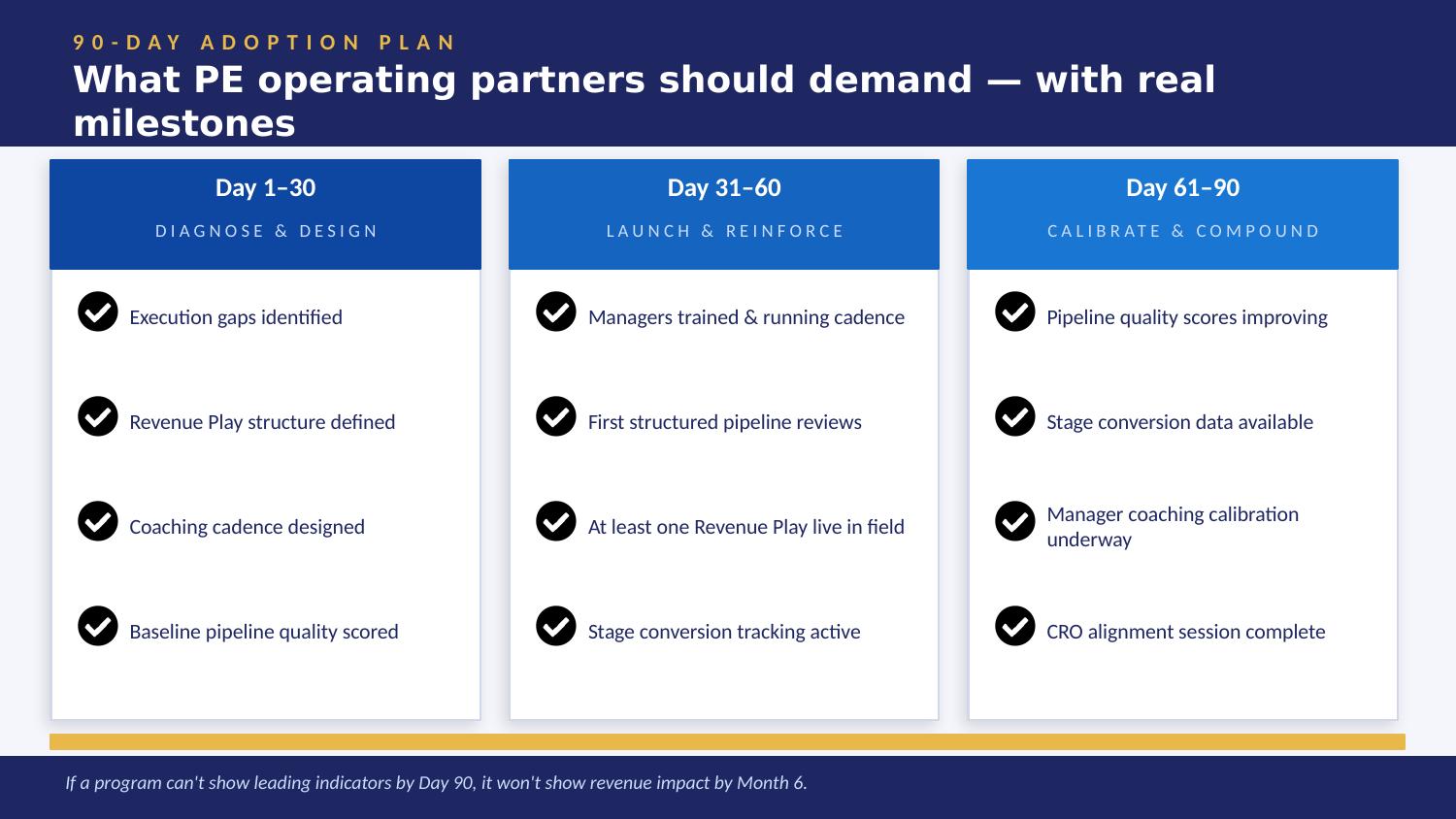
The first 90 days tell you whether the transformation is taking hold.
- Are managers running the cadence?
- Are reps using the plays?
- Is pipeline quality improving?
If those signs are missing, revenue results usually are too.
If a program cannot show leading indicators improving pipeline quality, managers running the cadence, reps executing the plays by day 90, it will not show revenue impact by month six. The sales effectiveness work has to move fast and show evidence early.
The strongest transformations start with clear expectations. Which plays are launching. Which managers are leading the effort. What success should look like in the first 30, 60, and 90 days. As Kodiak’s 7 Keys to a Successful Sales Transformation outlines, transformation fails when accountability is diffuse and milestones are vague. PE-backed companies cannot afford either.
What Winning Teams Do Differently
The companies that improve sales performance fastest after a PE acquisition are not the ones that trained the hardest. Rather, they are the ones that translated their growth strategy into a defined sales motion, built tools the field could actually use, and made managers responsible for coaching new behaviors consistently.
Most firms give you the playbook. Kodiak builds the sales team system that makes it run.
Kodiak Group has driven over $10 billion in incremental revenue across 300-plus enterprise engagements, including PE-backed transformations across distribution, manufacturing, software, and industrial sectors. If your portfolio company needs to improve sales performance fast, let’s talk.

One comment