

The CRO should own the sales kickoff. The CRO sets the strategic direction and is accountable for the outcome. Sales Enablement runs the program, RevOps handles the data and operational setup, and frontline managers reinforce the message after the event.
A sales kickoff is easy to plan and hard to make count. Whether it becomes a launchpad for execution or two days of presentations often comes down to one thing: clear ownership. That doesn’t mean one department owns everything; it means responsibilities are divided by decision, not job title.
Who is responsible for planning a sales kickoff?
The CRO is accountable, and the work is shared. Here’s how sales kickoff roles and responsibilities typically divide:
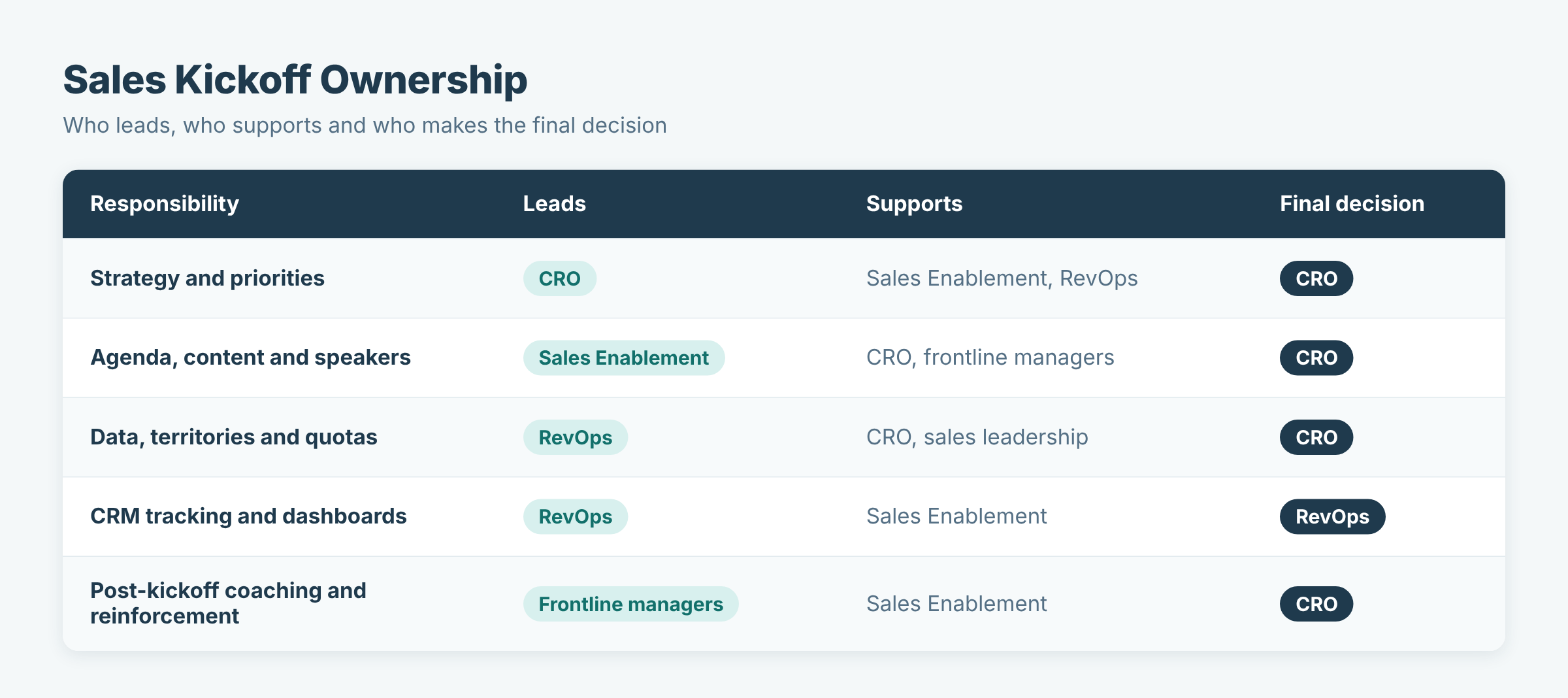
This works best when one person runs the day-to-day plan, and that is often Sales Enablement. Without a single lead, decisions bounce between functions. Without clear direction from the CRO, that lead is guessing at priorities.
The CRO role in sales kickoff: decide what it’s for
The CRO does not need to build every slide or choose every breakout session. But the CRO must answer the questions that give the kickoff its purpose:
- What must change in the next 90 days?
- Which revenue play deserves the team’s attention?
- What behavior should sellers and managers do differently?
- What evidence will show that the kickoff worked?
A useful test is simple: if a seller cannot explain the kickoff’s central priority in one sentence, the priority is not clear enough.
For a practical way to turn kickoff priorities into execution, see Kodiak’s guide to building a 90-day revenue play
What is the role of Sales Enablement in a sales kickoff?
Sales Enablement should own the operating system of the kickoff: the agenda, learning design, content, speaker coordination, practice, and post-event reinforcement.
That does not mean Enablement decides the strategy alone. It means Enablement translates the CRO’s priorities into an experience that changes what sellers do.
A strong Enablement leader does five things:
- Prioritizes ruthlessly. If leadership brings six priorities, Enablement helps determine which one or two can realistically change behavior in 90 days.
- Designs for application. Sellers should work through real accounts, objections, deal stages, and customer conversations, not passively receive product updates.
- Prepares managers first. Managers need to know what good execution looks like before they are asked to reinforce it. Research on manager coaching shows strong coaching can lift both quota attainment and win rates by double digits.
- Extends beyond the event. The kickoff is the launch, not the program. Without reinforcement, sellers can forget most of what they learned within 90 to 120 days, so the real work happens in the following 30, 60 and 90 days.
- Protects the agenda. Enablement must be disciplined about stakeholder requests for presentation time, ensuring only speakers and sessions that directly support strategic priorities make the agenda.
How should RevOps support sales kickoff planning?
RevOps should not be treated as the team that simply “sets up the CRM” after the strategy is decided. RevOps should be involved early because the data often helps shape the strategy. Their role is to turn strategic priorities into actionable sales execution by providing clear territory and account segmentation, identifying which accounts and prospects sellers should prioritize, and ensuring teams have the data and tools needed to execute new sales plays introduced at kickoff.
Before the kickoff, RevOps should validate:
- Win rates by segment, product, motion and seller cohort
- Pipeline coverage, conversion and deal progression
- Territory design, account assignments and quota readiness
- The CRM fields, dashboards and reporting needed to track the new play
- The leading indicators that will show whether adoption is happening
If the kickoff launches a new strategic-account play, RevOps should be able to show which accounts are eligible, what pipeline exists today, and how the team will know whether qualified opportunities are advancing.
Give every responsibility an owner
Before planning starts, put a name beside each decision: priorities, content, readiness and follow-through. Then give that team the tools to carry the kickoff into the field.
Get the free 2027 Sales Kickoff Toolkit → Nine practical tools, including an agenda builder, manager coaching cadence and 30/60/90-day reinforcement plan, to turn your kickoff into lasting execution.
FAQs
Who owns the sales kickoff?
The Chief Revenue Officer (CRO) owns the sales kickoff and is accountable for its results. The CRO sets the business objectives and overall direction. Other teams own specific parts of the work.
Should Sales Enablement or the CRO lead sales kickoff planning?
The CRO sets the strategy, and Sales Enablement leads the planning.
- CRO: Defines priorities and approves the direction
- Sales Enablement: Runs the agenda, speakers, content and logistics
When should you start planning a sales kickoff?
Start three to six months before the event. That gives:
- Leadership time to agree on priorities
- Sales Enablement time to build the program
- RevOps time to prepare data and operational details
What should RevOps prepare before a sales kickoff?
RevOps should prepare performance data and confirm the sales structure before the SKO:
- Performance data: Win rates, pipeline coverage and segment performance
- Sales structure: Territories, quotas and account assignments
- Reporting: CRM dashboards that track the kickoff’s priorities
What is the role of frontline managers in a sales kickoff?
Frontline managers connect the kickoff to the field. Before the event, they share the challenges their sellers face so sessions address real needs. After it, they coach and reinforce the new priorities with their teams.
How do you measure the success of a sales kickoff?
Measure success against the objectives you set before the event. Common metrics include:
- Seller understanding of key messages
- Adoption of new sales processes or plays
- Pipeline quality
- Win rates
- Progress against revenue targets