
When sales performance declines, the instinct is often to blame the sales team. But a performance drop rarely has a single cause. The Kodiak Five-Area Sales Diagnostic Framework helps revenue leaders identify where the revenue system is breaking down so they can prioritize the investment most likely to improve sales performance.
Revenue is down. Quota attainment is slipping. Forecasts are becoming less reliable. Leadership knows something is broken, but the harder question is determining where to focus first.
- Is the problem your strategy?
- An inconsistent sales process?
- Messaging that no longer resonates with buyers?
- Managers who aren’t reinforcing the right behaviors?
- Or does the team simply lack the tools and enablement needed to execute consistently?
Many organizations respond by placing one large bet: a new sales methodology, sales leader, messaging refresh, technology investment, or training program. Each may address a real issue but without first identifying the underlying gap, the investment may miss the problem.
The Five Areas Every Revenue Leader Should Examine
The Kodiak Five-Area Sales Diagnostic helps revenue leaders examine the five parts of the sales system that influence execution and results:
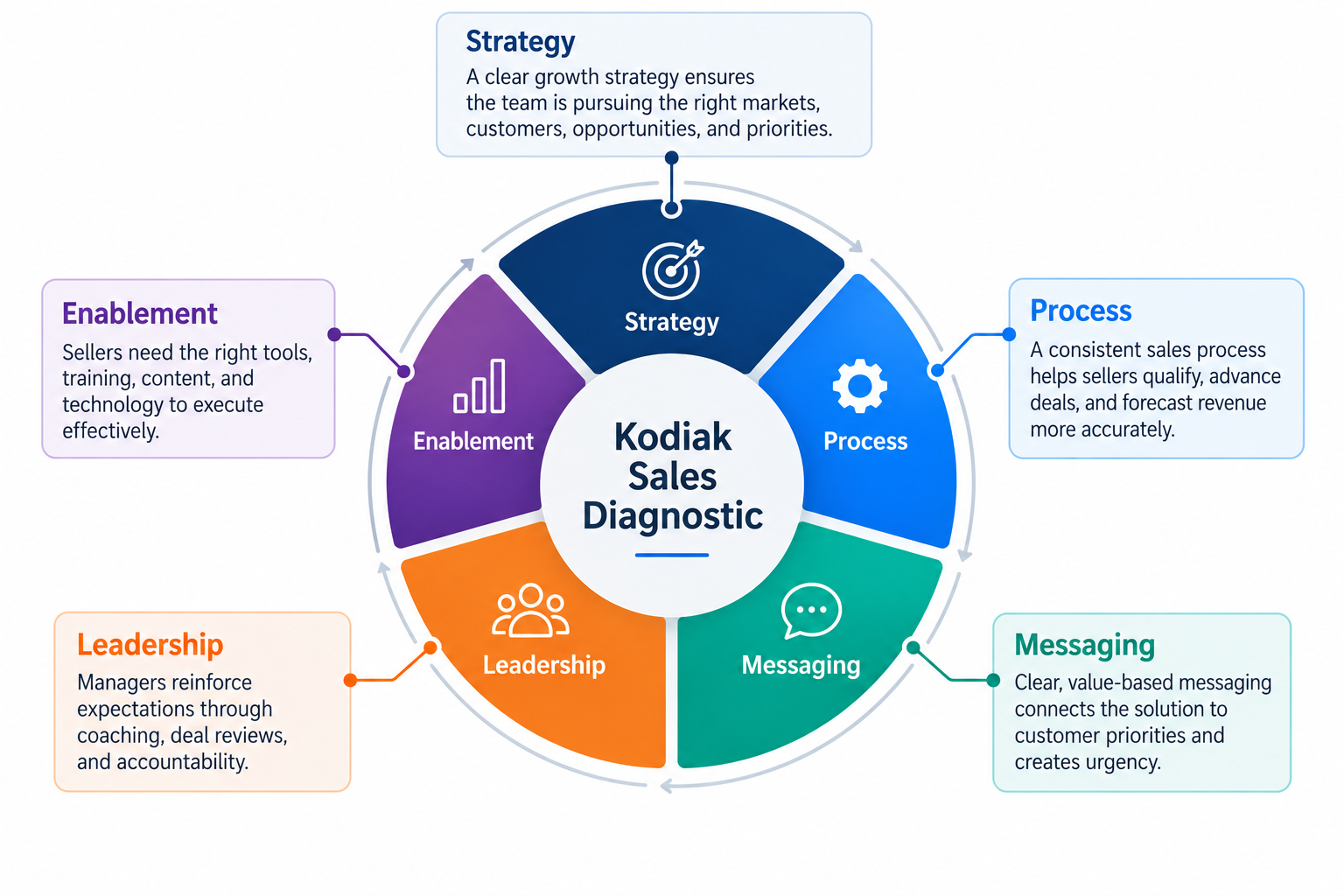
Strategy
A strong sales organization starts with a clear growth strategy. Teams need confidence that they are pursuing the right markets, customer segments, opportunities, and priorities.
Questions to consider:
- Are we targeting the right customers and opportunities?
- Are our growth priorities aligned with current market conditions?
- Is our ICP (Ideal Customer Profile) still accurate, or has the market shifted?
Why it matters: If strategy is unclear, sellers may continue pursuing the wrong opportunities, limiting conversion and win rates.
Process
Even experienced sellers struggle when every opportunity is managed differently. A consistent sales process helps teams qualify opportunities, advance deals, and forecast revenue more accurately.
Questions to consider:
- Does every seller follow the same sales process?
- Is the process aligned with how customers actually make buying decisions?
Why it matters: Hyperbound reports an average sales win rate of 21%. A benchmark like this can help leaders identify when conversion is deteriorating, but the number should be interpreted in the context of deal stage, segment, market, and sales motion.
Messaging
Sellers need messaging that clearly communicates business value, creates urgency, and connects solutions to customer priorities.
Questions to consider:
- Can sellers consistently articulate our value proposition?
- Does our messaging address customer challenges and business outcomes?
- Is messaging tested and reinforced through coaching, or left to individual interpretation?
Why it matters: When messaging is unclear or inconsistent, even well-qualified opportunities can stall. Buyers may not understand why they should choose your solution over the status quo.
Leadership
Sales managers play a critical role in reinforcing performance. Consistent coaching, opportunity reviews, and accountability help turn strategy into daily execution.
Questions to consider:
- Are managers coaching consistently across the team?
- Do they reinforce the behaviors that drive performance?
- Is coaching frequent enough to show measurable results?
Why it matters: Without manager reinforcement, even a strong strategy or process can fail to translate into consistent execution.
Enablement
Training, content, technology, and sales tools should make it easier for sellers to execute effectively.
Questions to consider:
- Do sellers have the tools and resources they need at each stage of the sales process?
- Is training reinforced through ongoing coaching and practical application?
- Are new hires receiving structured onboarding and coaching?
Why it matters: Effective enablement can reduce the time sellers spend on non-selling activities and make it easier for them to focus on customer-facing work. McKinsey found that leading B2B companies opened up about 20% more sales-team capacity by offloading and automating non-selling activities.
How to Decide Where to Focus First
Performance metrics can show that a problem exists, but they do not always explain why. The strongest diagnosis combines data with what is happening in the field.
Start With the Data
Review:
- Quota attainment
- Win rates
- Pipeline conversion
- Forecast accuracy
- Sales cycle length
Then compare those signals with seller and manager behaviors.
Customer feedback, lost-deal reviews, and pipeline movement can add context and help distinguish whether the issue is rooted in strategy, process, messaging, leadership, or enablement.
Then Observe the System
Look at the tools, technology, training, and enablement resources available to the sales team.
The goal is to connect performance data to how the organization actually operates.
From there, prioritize the gap with the strongest combination of:
Business impact + evidence + feasibility
That creates a more informed basis for deciding where to invest.
Making the Right Investment
When sales are down, the most important decision is not which solution to buy or which initiative to launch.
It is where the revenue system needs attention.
Kodiak’s Sales Diagnostic helps organizations evaluate strategy, process, messaging, leadership, and enablement, identify significant performance gaps, and prioritize the investments most likely to improve sales performance.
FAQs
Why are sales down even though the team is working hard?
Effort isn’t usually the issue. Sales performance rarely declines because of one cause, it’s often a combination of strategy, process, messaging, leadership, and enablement gaps working against each other. This is why a single fix such as a new tool, hire, or training program may not move the needle.
What questions should leaders ask when sales are down?
Start with the five areas that make up the revenue system: Are we targeting the right customers and market conditions? Does every seller follow the same sales process? Can sellers consistently articulate the value proposition? Are managers coaching consistently and reinforcing the right behaviors? Do sellers have the tools and resources they need at each stage of the sale?
How do you diagnose declining sales performance?
Look beyond top-line revenue. Review quota attainment, win rates, pipeline conversion, forecast accuracy, and sales cycle length alongside seller and manager behaviors, customer feedback, and lost-deal reviews. Examining data and behavior together shows whether the breakdown is in strategy, process, messaging, leadership, or enablement.
What is the Kodiak Five-Area Sales Diagnostic?
It is a structured evaluation of an organization’s strategy, process, messaging, leadership, and enablement, used to identify significant performance gaps and prioritize where to invest before committing to a fix. Rather than prescribing a solution first, the diagnostic helps leadership teams understand where their revenue system is actually breaking down.